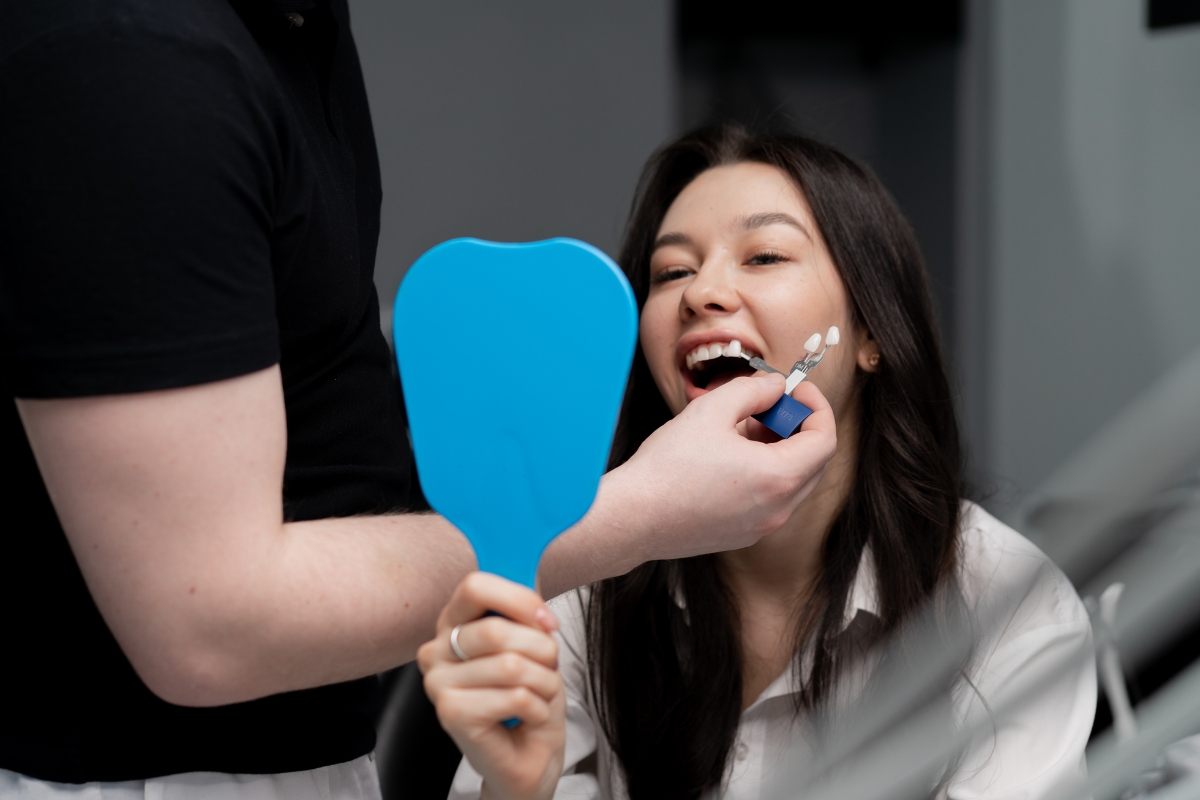
Have you ever had a new filling or crown placed that felt kind of foreign? It was smooth as silk, it wasn’t pointy and the bite felt just right. But yet, it was different. Your tongue acted like it would never get used to it, constantly running circles around the newness of it.
Do you remember what happened to it? Yup. You forgot about it. A day or two later, it didn’t feel new. How does that work? I mean, two days ago you were pretty sure that you were going to need to call the dentist. There had to be something wrong with this weird new filling. But now you’re not even sure what tooth it is. How bizarre is that?
It’s actually not bizarre at all! In fact, it means your nervous system is working just perfectly.
Neural adaptation or sensory adaptation is a change over time in the responsiveness of the sensory system to a constant stimulus. That’s a very fancy way of saying, “you just get used to it.” Our nervous system is constantly taking in all kinds of sensory data. What we hear, what we see, what we smell, taste and feel are all giving constant input to our brain. The thing is, not all of this information is all that important at any given time. So the brain has to be able to filter out the stuff that isn’t important while keeping track of the sensory information that is.
Once the brain and nervous system has figured out which information isn’t important at the moment, or salient, it can filter this information out. That way the brain can focus on more important sensory input.
"this is going to be cold!"
My favorite example of this adaptation has to do with swimming in the lake. Each 4th of July weekend for as long as I can remember my cousins and I spend as much time as we can in the lake. Even in early July, when the temperature is in the mid-80′s that lake always feels really cold. At first. If you creep into the lake slowly, just a couple steps at a time, it stays excruciatingly cold. But the longer you’re in, and the more of your body gets wet, the less cold the water feels. Pretty soon, we’re splashing around in the water like it was a bathtub. What happened? Did the water change temperature? Probably not. We just got used to the temperature.
There are probably great survival reasons for our brain to be wary of the shocking cold we feel when we make our way into the lake. We have to maintain our temperature between certain parameters and if our brain feels like this is threatened, it’s going to continue to sound the alarm. After you spend a little time in the water and your survival doesn’t seem threatened, the temperature stops being such a salient stimulus. Your brain begins to focus on other things, like the squishy bottom of the lake or your cousin attempting to dunk you.
So, back to that new crown or filling. It feels new and weird for a little while because it’s a constant and different stimulus to what your brain had been used to up to that point. The longer it stays there without causing a big problem, the more your nervous system discounts the stimuli coming from the touch receptors in your lip, cheek and tongue. Over time, the new filling begins to feel like the norm. Most of the time my patients have gotten very comfortable with their provisional (temporary) crowns and will have to go through the same process with their new crown.
So the next time you have some dental work done and your tongue keeps telling you that there’s something funny going on, just remember that it’s just like jumping into the lake. After a little while, you’ll get used to it!
Did you find this post interesting? Silly? Earth shaking? I’d love to hear about it! You can share any Mead Family Dental post with a “Like” on Facebook, a “+1″ on Google+ or you can even “Tweet” it with Twitter! All you need to do is hover over the heart shaped button next to the title of the post. Or you can leave a comment by clicking on the balloon shaped icon next to the title.
If you’re looking for a dentist in Saginaw, we’re always happy to accept new patients! You can request an appointment online or call the office at (989) 799-9133. And, as always, you can email me at alan@meadfamilydental.com. I always answer my own emails!
No, really. There are plenty of general dentists that love doing cosmetic dental work. There might even be dentists that limit their practice to esthetic cases. However, a dentist cannot be officially designated a “cosmetic dentist” or “cosmetic specialist.”
Public Health Dentistry: this field of dentistry is involved in the assessment of dental health needs and improving the dental health of populations rather than individuals.
Endodontics: deals with the tooth pulp and the tissues surrounding the root of a tooth. They perform root canal treatments and retreatments.
Oral and Maxillofacial Surgery: these dentists treat a wide spectrum of diseases, injuries and defects in the head, neck, face, jaws and the hard and soft tissues of the oral and maxillofacial region. Oral surgeons remove injured or diseased teeth, treat oral cancers and deal with temporomandibular joint problems.
Oral and Maxillofacial Radiology: is the study and radiologic interpretation of oral and maxillofacial diseases. They are trained in reading and interpreting x-rays of the head and neck.
Orthodontics: focuses on the straightening of teeth and modification of midface and mandibular growth.
Prosthodontics: specializes in replacing missing teeth using crowns, bridges, implants and removable prostheses.
Pediatric Dentistry: specializes in treating dental diseases in children and adolescents.
Periodontics: specializes in treating the supporting tissues of the teeth such as the gums and the bone that surrounds the teeth.
Oral and Maxillofacial Pathology: specializes in the diagnosis of less common dental and head and neck diseases.
General dentists are allowed to perform procedures within any of the specialties, if they choose to. However, as of right now a dentist cannot “specialize” in cosmetic dentistry. Kind of confusing, right? Let me explain a little more.
Let’s say you go to a general dentist with a toothache. The dentist performs some tests, takes an x-ray and determines that your tooth has an infection and will need a root canal. Many general dentists perform root canal treatments in their office while others might prefer to refer root canal procedures to a specialist called an endodontist. Some dentists will choose to do some, but not all of these procedures themselves for different reasons. Perhaps they don’t enjoy doing them, they don’t find them time efficient or perhaps the tooth is particularly challenging. The endodontist has specialized training in root canal treatments. By choosing to specialize in root canals the endodontist doesn’t spend their time placing crowns or making dentures. They get very good at a very specialized procedure.
So you may wonder why there isn’t a cosmetic dentistry specialty. My best answer is that cosmetic treatments are often “interdisciplinary” in nature. I’ve treated cosmetic cases where we first sent the patient to the orthodontist, to straighten their teeth and make room for a dental implant. Then sent them to an oral surgeon to place a dental implant. Finally, we whitened the patient’s teeth and restored the implant with a beautiful porcelain crown. The goal of all of this treatment was cosmetic improvement, but it involved a team of specialists organized by me, the general dentist. Some general dentists may have the skills required to do all of the different phases I’ve described. But for now, there’s no cosmetic dentistry specialty.
How can you know if your dentist has skill with cosmetic dentistry? The very best way to know is ask them! Dentists who do a lot of cosmetic dentistry usually take photos of their work. Not only is this a great way to show other patients what cosmetic dentistry can offer them but it helps them see what they can do differently or better for the next time. Dentists who enjoy doing cosmetic cases usually take a lot of continuing education classes in order to learn new and cutting edge techniques. Be sure to ask your dentist if they’ve taken courses on cosmetic dentistry.
And remember, cosmetic dentistry isn’t limited to super expensive veneer cases! Orthodontics (braces) and whitening can give a really dramatic result with little or no “drilling.” Replacing stained fillings or replacing silver fillings can lighten the color of your smile, too. Dentures can make a huge cosmetic difference for some people even though most people don’t really think of dentures as “cosmetic dentistry.”
Would you like to improve your smile? I’d be happy to take a look. I don’t charge anything for a cosmetic consultation. I can take a look and give you some ideas about what we could do to improve your smile. I’m also always available for second opinions at no charge! We place beautiful cosmetic restorations every day at Mead Family Dental, but remember…I’m not a “cosmetic dentist!”
Did you like this post? Would you like to share it with friends? You can click on the heart shaped icon next to the title of this post and automatically share it on Facebook, Twitter or Google+! Or you can leave a comment by clicking the “ballon” shaped button next to the title. Or send me an email at alan@meadfamilydental.com. I’m happy to answer any questions and appreciate your input! If your looking for an improvement in your smile in Saginaw, MI I’d like to help!
This research was a literature review or a "study of studies." Many of these studies had hypothesized that there was a causative connection between asthma and tooth decay but data didn't support this hypothesis.
Inhalers used in the treatment of asthma can cause a dry mouth. Dry mouth is a major risk factor for tooth decay. To be clear, this research determined that having asthma isn't a risk factor for tooth decay, but using inhaler medications is a risk factor for dry mouth and dry mouth is a risk factor for tooth decay. If you use inhalers I would recommend chewing sugarless gum after their use to bump up your saliva flow. Along with regular brushing and flossing these precautions should help protect you against any drying that might occur from this medicine.
Do you have dental topics you'd like me to research and discuss? I'd be happy to! Feel free to drop me an email at alan@meadfamilydental.com. I take requests!
Before I’m accused of being a corporate shill for Hershey’s (I can see the headlines: “Saginaw Dentist Sells Out to Chocolate Company!”) let me explain.
It seems that Ice Breakers Ice Cubes are the only gum sweetened with xylitol that can be found easily in stores. There are a ton of xylitol gums out there, but I just haven’t seen them around. If anyone else has, please feel free to comment and prove me wrong.
Why should you care? Because xylitol is proven to be good for teeth. Specifically, xylitol cannot be broken down by the bad bacteria found in your mouth in the same way that regular sugars are. Which means that xylitol cannot be used to create acid by those bacteria, which means that this acid can’t attack your teeth and cause cavities.
Even better is the fact that xylitol is taken up by the bad bacteria and they can’t do anything with it. For lack of a better description…it kind of constipates them! Over time, using a xylitol gum can actually change the make up of the bacteria in your mouth. It actually gives the advantage to the “less bad” bacteria! Cool stuff.
So all the gum chewers out there need to go out and try some xylitol gum. Check the ingredients on the box and try it out. Your teeth will love you for it!
If you have any questions or comments please feel free to email me at alan@meadfamilydental.com. We would love to hear from you!
Let’s face it…saliva gets no respect. Most people think of it only as drool or slobber instead of the vital part of oral health that it truly is. With that in mind…I give you “10 things you probably didn’t know about saliva/spit.”
10) Saliva is about 98% water. The rest of saliva is made up of electrolytes, mucous and various enzymes.
9) Llamas often spit at attackers when they feel threated and will spit at each other to help establish their pecking order.
8 ) Chemical digestion of food begins in the mouth with the enzyme amylase, which is contained in the saliva. Amylase breaks complex carbohydrates (starches) into smaller carbohydrates (sugars). You might notice that potato can taste sweet as it’s being chewed and this is due to the action of amylase.
7) Saliva (pictured) is a rock band that formed in Memphis in 1996. They are best known for their 2001 metal/hip hop crossover “Click Click Boom.”
6) The bacteria in human plaque turn the sugary foods that we eat into acid. This acid, as well as acids from the foods we eat, can cause a drop in the pH of our mouths which is the cause of cavities in our teeth. Enzymes found in saliva help to neutralize these pH changes and maintain a healthy acid/base balance in our mouth.
5) Saliva contains many antibacterial compounds like lysozyme, lactoferrin and peroxidase. There is some animal research that suggests that wounds licked with saliva heal faster than those that aren’t. These studies were not conducted in humans although it is interesting to note that wounds inside the mouth tend to heal much faster than those on skin (external to the mouth).
4) Saliva carries Calcium and Phosphate ions which help to reverse damage done on the tooth surface (“pre-cavities”)
by bacterial acids.
3) A spit is a kind of a land form or sand bar that develops when the direction of the shoreline turns inland or “reenters.” This causes currents and waves to drop the sediment they are carrying and forms a kind of a depositional sand bar. The largest spit in the U.S. is called the Dungeness Spit (pictured) and it is located in Sequim, WA.
2) Saliva serves to lubricate the lips, tongue, cheeks and other parts of the mouth. If you’ve ever had a dry mouth you know that it can be hard to speak or swallow when you’re low on saliva. Many people with certain illnesses or taking certain medications suffer from chronic dry mouth, called xerostomia, which puts them at greater risk for cavities and other dental problems.
1) A healthy human creates between .75 and 1.5 liters of saliva every day. Salivary flow is reduced to almost zero during sleep which is one very good reason to brush and floss just prior to going to bed.
I hope this primer has given you a different perspective about saliva. The next time you hold a drooling baby or notice your mouth water at some delicious aroma you can be thankful for it’s important role!
If you have any questions about this post or any other tooth/mouth related questions for that matter, drop me an email at alan@meadfamilydental.com. I would be happy to reply or even better, I’d love you help you with all of your dental health needs! Feel free to call and make an appointment at (989) 799-9133!